A Baron with a Mitre — Why Alexander Built Newark, Sleaford, and Banbury
Why would a Bishop (re)build a Castle?
When we picture a medieval bishop, we often imagine a pastoral figure in robes. But in the 12th century, bishops were powerful landowners who travelled widely, held courts, and managed huge estates. They were part of the political landscape as much as the spiritual one.
That is why Bishop Alexander of Lincoln built castles. For him, they were not symbols of war but working centres of administration — places where he could govern a vast diocese that stretched from the Humber to the Thames.
The Diocese as a Territorial Power
Lincoln was the heart of Alexander’s authority, but the diocese was far too large to manage from a single city. It covered busy market towns, river crossings, and some of the most productive farmland in England. To keep this huge area functioning, the bishop needed more than a palace at Lincoln — he needed reliable bases across the region.
The landscape was already full of baronial castles and fortified manors. Alexander’s own sites fitted into this world, not as military rivals but as practical centres where he could hold court, manage estates, and travel safely.
Newark, Sleaford and Banbury became the key points in this network.
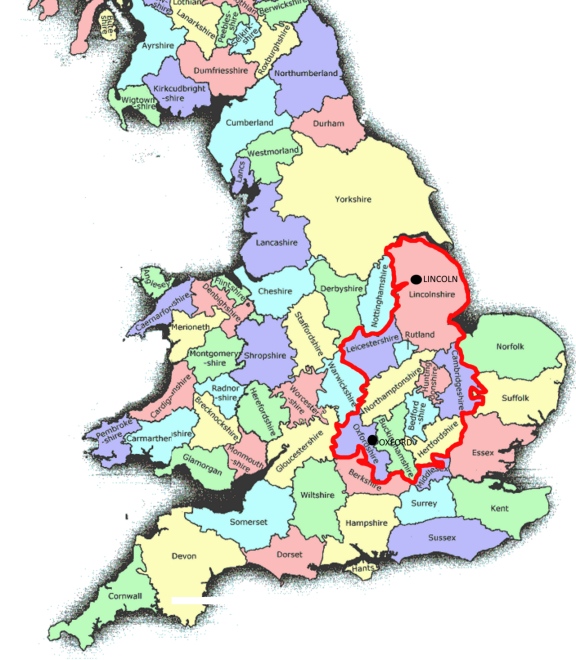
Bishop Alexander’s Lincoln DIocese © Wikimedia Commons https://commons.wikimedia.org/wiki/File:Medieval_diocese_Lincoln.png

Newark: The Northern Base of Operations
Newark’s position made it essential. The River Trent and the Fosse Way brought people, goods and information through the town from every direction. Anyone travelling between the Midlands and the north passed Newark; anyone using the river encountered episcopal authority here.
Alexander rebuilt the earlier timber castle in stone, giving Newark a permanent and unmistakable presence. Its riverside frontage was designed for access, not defence, and the Gatehouse — still standing today — controlled movement into the complex.
Newark became the bishop’s main northern base: a place to stay, to work, and to oversee the estates of the upper diocese.
4. Sleaford: The Eastern Anchor
Sleaford Castle, built in the 1130s, may sit quietly today, but in Alexander’s time it stood on an important east–west route. It was one of the bishop’s major estates and provided a secure place to conduct business while travelling through the southern half of the diocese.
Like Newark, Sleaford was not a fortress braced for war. It was a working centre — a place for meetings, administration and hospitality. Together, Newark and Sleaford allowed Alexander to move confidently across his territory.
5. Banbury: The Gateway to London
Banbury Castle completed the picture. Positioned on the main route to London, it gave Alexander a safe and reliable base close to the royal court. It strengthened the bishop’s presence in a region where church and Crown interests often overlapped.
With Newark in the north, Sleaford in the centre, and Banbury in the south, Alexander created a practical network that allowed him to govern effectively across one of the largest dioceses in Europe.
6. A Network Built for Turbulence
Alexander’s career unfolded during a turbulent period. After the death of Henry I in 1135, England fell into civil war — a struggle known as The Anarchy. Loyalties shifted, and the structures of government were strained.
In 1139, Alexander was arrested by King Stephen, accused of supporting the Empress Matilda. His castles, including Newark, were seized. This dramatic moment shows how important these sites were: they were valuable enough for the Crown to take and central enough to be contested.
Alexander’s network was not decorative. It was essential.
7. Closing Reflections: Newark at the Centre
When we stand inside Newark Castle today, we see the later medieval walls, the riverside tower and the Gatehouse. We see a rare survivor of Episcopal power. But beneath these layers lies the logic of Alexander’s world: a diocese managed through a series of working centres, each chosen for its strategic position and practical value.
Newark was the northern keystone of that system. It remains the most visible reminder of Alexander’s ambition and the administrative world he helped shape.
The next blog will return to the Gatehouse to explore its conservation — and look again at Sleaford Castle, Newark’s now‑missing cousin.
And Finally — Newark’s ‘Second Castle’
While walking through the town this week, I took a closer look at Newark’s unofficial “second castle”: the multi‑storey car park. With its long curtain‑wall façade, turret‑like corners, fortified windows and controlled entry point, it bears a surprising resemblance to its medieval neighbour. Whether this was intentional or simply a happy coincidence is a question for the Planning Department — or perhaps just a sign of an over‑active heritage imagination.

The ‘curtain wall’

The ‘fortified windows’

The ‘secure gatehouse’
