Framed Views and Quiet Progress - Reading the Castle Through Windows and Stone
Introduction — Seeing the Site as the Public Sees It
I began today’s site visit in the castle gardens behind the registry office, looking through the public viewing window that frames the works. It is a wide aperture, perhaps reflecting the breadth of activity underway, and it reminded me to centre this week’s blog on windows — and that the blog itself acts as a window into the Gatehouse Project.
The Gatehouse sounded busy, with considerable masonry movement echoing across the site. Going up the scaffold this week would have been too intrusive. The site foreman briefed me that preparatory work has begun on restoring the chimney, and that the noise was stone and rubble being moved as the team readies the structure for the next build phase.
The masons are doing as their predecessors did: manually shifting stone around the Gatehouse to prepare for what comes next. There was a quiet satisfaction in knowing this, even amid all that noise.

The viewing aperture - giving members of the public a window into site activity

The generous view from that aperture
Visible Change — The North‑West Tower and Garden Paths
The most striking change today was the ‘pop’ from newly cleaned masonry at the foot of the north‑west tower. What appeared as a uniform grey mass now shows its true palette: warm stones, cooler tones, and the irregular mix that reflects centuries of repair and rebuilding.
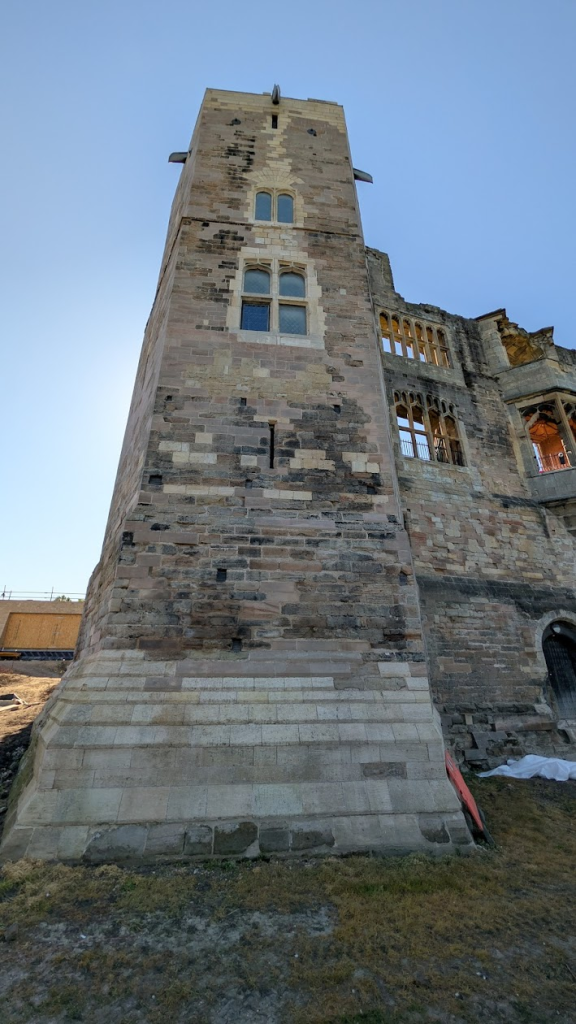
The north-west tower showing the newly cleaned masonry.
Walking the perimeter, the newly laid garden paths towards the Trent are beginning to assert their geometry. At this early stage they look almost too crisp, like the outline of a miniature Formula 1 circuit. That starkness will soften when planting occurs, but for now the design is legible.

The new garden paths - reminding me of a mini-Formula 1 circuit
The garden room also reads more clearly up close: light, deliberate, and respectful of the medieval fabric — related, but clearly a separate addition.
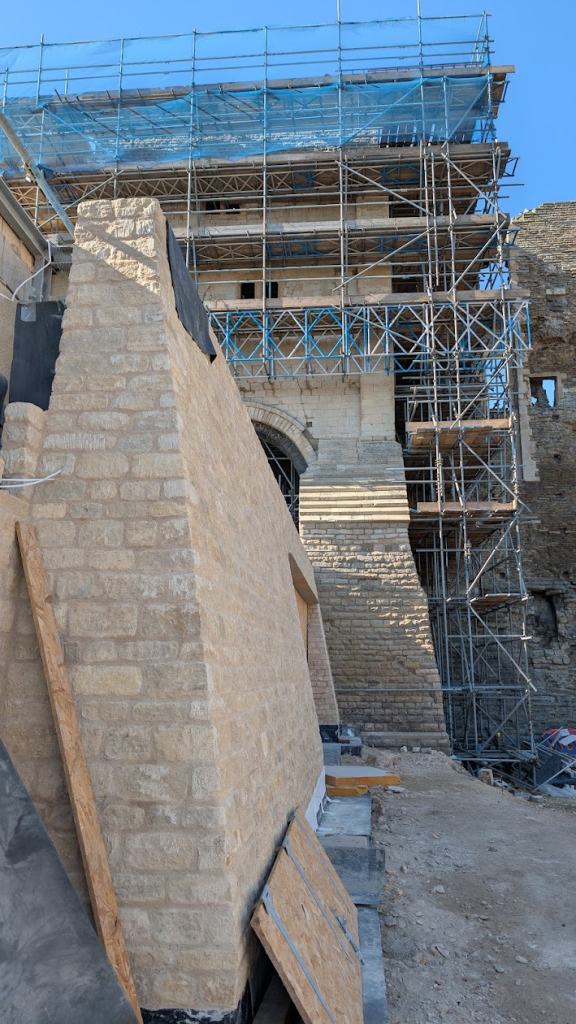
A view of the garden room wall facing into the Gatehouse
The discovered well remains exactly as it was. No further insights this week, no new interpretation, no fresh evidence. It sits quietly in the centre of the Gatehouse — unchanged and waiting for the moment when the project turns its attention back to it. Not every visit brings revelation; sometimes the value lies in confirming what has not moved.
A Window That Changed Its Mind — The Abandoned Round Opening
At the Gatehouse, one detail continues to intrigue me. On the external wall are remains of a round window that was begun and later abandoned. Round windows are not easy to build; cutting a true circle in stone requires precision and confidence. You do not start one unless you intend it.
Yet here, the circle was only partially formed before the plan changed. The opening was abandoned and re-worked, leaving a curve visible in the masonry — easily missed unless you know it is there. It is the physical record of a decision made mid‑build. Something altered: function, fashion, structural judgement, or the patron’s instruction. We do not know which, but the stone preserves both the intention and the change.
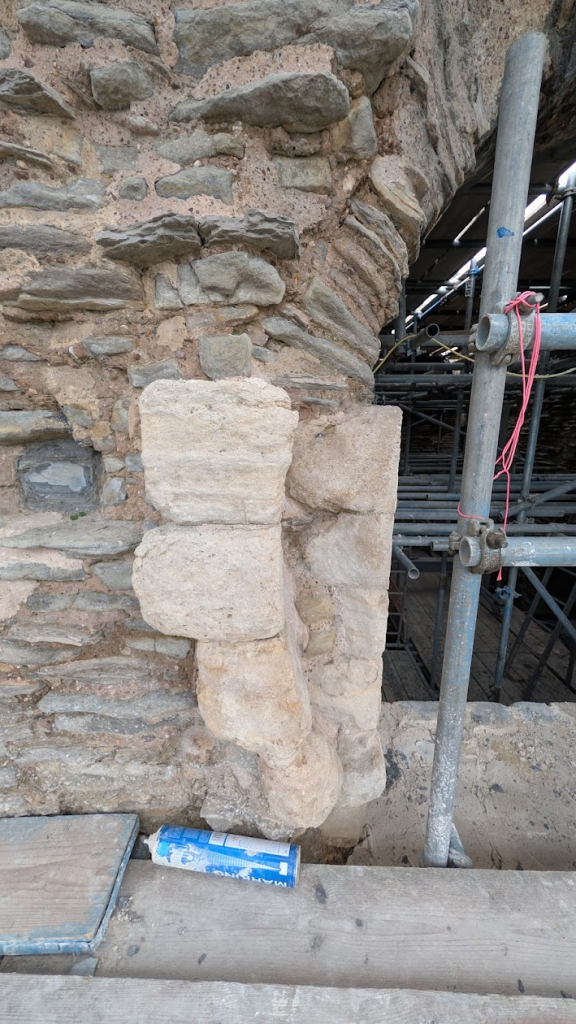
The left side of the round window showing the clear arc
Round windows are familiar in cathedrals and major churches, where they often signal status, resources, and skilled labour. In a secular building like the Gatehouse, the meaning is less certain. It may have been intended to admit controlled light, perhaps even to frame the bishop’s throne. The idea is plausible, but we cannot assert it. The evidence tells us only that the circle started, and then stopped.
What We Cannot Know — Glazing, Shutters, and the Lived Reality
During a recent visit, our little group discussed glazing. The truth is that we do not know if any windows in the Gatehouse were glazed at the time of construction. Glass was available, but expensive and often imperfect. Even in high‑status buildings, glazing was not universal. If the windows were glazed, they were likely fitted with plain glass rather than painted, (which would have increased the cost significantly).
It is equally possible that some openings relied on timber shutters. Heavy shutters were practical, easy to maintain, and effective at retaining heat in winter. In summer, they could be opened to allow ventilation, often paired with internal curtains or hangings to soften the light. These combinations were common long before glazing became widespread.
The uncertainty is part of the building’s story. The masonry gives us clues — the size of apertures, the depth of reveals, the presence or absence of rebates — but not a complete picture. Modern conservation accepts that. Instead of imposing a definitive interpretation, it preserves the evidence so future researchers can continue to read the building.

A round window ‘at scale’ from nearby Lincoln Cathedral on a rather grand scale compared with Newark Castle’s modest ambition.

A ‘Newark Castle sized’ round window at Jarrow Monastery, made from excavated glass during archeological works in the 1960’s (thought to be the oldest stained glass window in the world).
Looking Ahead — The Next Phase of Work
Although site access was constrained today, it is clear that the next phase is taking shape. The steel frames for the visitor experience are due shortly. When they arrive, visual progress will accelerate again. The Gatehouse will begin to reveal its new internal structure, and the project will move from preparatory work back into visible construction.
For now, the changes are quieter: cleaned stone, new paths, careful masonry, and the steady preparation for the chimney rebuild. These quieter phases matter - foundations for what comes next.
Conclusion — Seeing the Castle Through Time
Returning to the public viewing window, I was reminded that every perspective on the Castle is partial. The public sees a framed moment. I see a sequence of visits. The masons see the work in front of them.
The building itself carries the record of centuries — decisions made, altered, abandoned, and preserved in stone.
Today’s progress was not dramatic, but it was significant. Looking through ‘my' window, it is clear that the Gatehouse is continuing to live its history, one detail at a time. And in a few weeks, when steelwork arrives, the next chapter of its long and venerable life will unfold….