The Masons Brief - The Hidden Work
A Second Look From the Gatehouse
On my last visit to the Newark Castle Gatehouse I gathered far more material than one blog could hold. This second piece draws on that material and focuses on progress made on the Gatehouse viewing platform — a feature that will open up a perspective unseen for centuries by anyone other than those tasked with maintaining the building.
Why a Roof Matters
Putting “a new roof” back on the Gatehouse serves two purposes. Firstly, it creates a viewing platform that gives visitors a new sense of the castle and its setting. Secondly, and perhaps more importantly, it seals the internal fabric of the Gatehouse, reducing the weathering that an open ruin inevitably suffers. It’s easy to think of a roof as a simple covering, but at the Gatehouse Project it becomes part of a much larger conversation about preservation, access, and responsibility.
Stonework That Does More Than One Job
As I walked the scaffolding level directly beneath the roof, I noticed how the new courses of stone — deliberately distinct from the medieval work — serve multiple purposes. What stood out were the deeper stones, which at first seemed counter‑intuitive until seen from above.
Up on the roof, I asked one of the masons to explain what I was seeing. He pulled back the protective tarpaulin — with evident pride that someone had noticed the work — revealing the full, crisp run of the new course. He explained how the Gatehouse masonry is far from symmetrical, and how that irregularity had prompted many early conversations about how to achieve this neat line.
Those larger stones I had noticed square the corner off and provide the solid foundation needed to lay this new, straight run. The deeper slabs, taken from the site, were ideal for unlocking this puzzle: they created the stable base from which the corners could be built up and the masonry line brought into true square.
The precision and ingenuity are striking. Yet, like much of this work, it will soon be hidden beneath the platform — quietly enabling and anchoring everything that follows.
At the foot of the picture you see the large slabs that bring a corner of the Gatehouse into true ‘square’ above, and anchor the new masonry above.
And above, on the roofline the intervention makes much more sense, revealing the whole run of masonry.

At the foot of the above picture you see the large slabs that bring a corner of the Gatehouse into true ‘square’ above, and anchor the new masonry above.
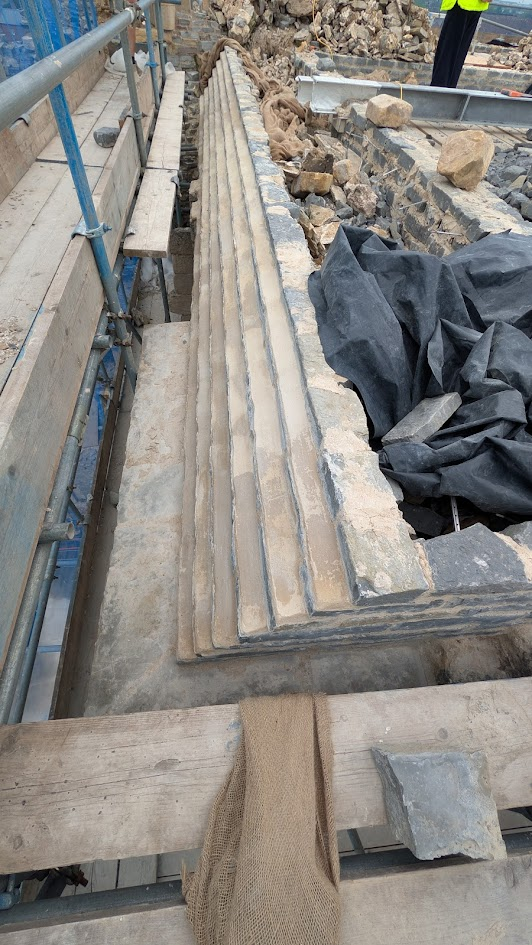
And above, on the roofline the intervention makes much more sense when revealing the whole run of masonry
A Ruin That Begins to Live Again
This work marks a subtle shift: the Gatehouse is no longer simply a ruin. It is beginning to assert itself again. The new access route reframes the whole site — from “a garden with a castle” to “a castle with a garden.”
The stonework blends old and new, but it also shows how masons interpret the medieval fabric and carefully augment it to serve new purposes. It also shows how they think about weather — shaping stone to avoid standing pools of rainwater and to keep water moving away from otherwise vulnerable fabric.
Angled stonework and deliberate falls work together to keep water off the structure. You only appreciate the intelligence of it when you stand close.
A Practice Rooted in Respect
What also strikes you, watching this work, is how much of it is about respect. Respect for the original masons, whose decisions still shape the building. Respect for the materials, which have endured centuries of weather and can still be reworked into modern interventions. Respect for the future, because every intervention must be reversible, gentle, and honest. The castle has waited centuries for this, and clearly the masons think it deserves patience and careful consideration as it is brought back to life.
Seeing the Building With New Eyes
Ascending the scaffolding brings you face to face with external features that normally sink into the background. It changes how you see the Gatehouse. You start to notice those details — how the building has been reworked across different periods to serve fashions and needs, and how, even though it was slighted after the English Civil Wars, it has defiantly withstood that abuse to present itself as a canvas for modern interpretation and preservation.
The Work Nobody Notices — But Everything Depends On
There is something humbling about realising how much of the castle’s survival depends on ‘hidden’ work that visitors might never see. People will admire the façade, admire the river view, and enjoy the drama of the ruin from the viewing platform, blind to the craft under their feet that made it possible.
Visitors will not notice the repaired joints, the discreet interventions, or the careful pointing. Yet those quiet acts of conservation are what will make the castle accessible and relevant in this next exciting phase of its long and venerable life.
Heritage is celebrated in its grand gestures (and what a gesture the castle is!), but it is preserved in the quiet ones too.

The logic of the viewing platform is beginning to emerge with crisp masonry emerging across the roofline.
A Living Structure, Not a Frozen Monument
Spending time on site reminds you that the castle is not a static relic. It has been managed, repaired, adapted, and cared for across centuries. Every generation has left its mark — some lightly, some heavily — and the current work is simply the latest chapter.
The medieval masons who built Newark Castle would recognise the principles behind today’s conservation work. They would understand the need to keep water out, to deflect it away, to stabilise the stone, and to respect the building’s weight and balance.
What they would not recognise is the idea of the castle as a ruin. For them, it was a working building — a place of authority and activity. The roof was not a feature; it was a necessity. In the strange circle of history, their legacy lives on as today’s masons bring the Gatehouse back to life.
And for this Project it is equally a necessity — to secure the fabric and allow the Gatehouse’s next life to be lived to the full.
Next week I hope to return to the site to bring a progress update, and to begin sharing some of the additional material I gathered last visit, about the curious tale of the round window….