Routine’ Work, Unexpected Depths — A Gatehouse That Still Surprises
Returning to Site
I returned to the Castle site for this Blog after the Easter break, and after a short three‑part historical series setting out the early history of the Castle and Bishop Alexander. This week I joined the archaeological team and Dr Pamela Marshall — a renowned academic specialising in the history of English and French castles — to hear about a rather surprising discovery.
Since services are required in the Gatehouse, a narrow channel of the modern floor had been carefully cut (specifically to avoid disturbing the historic ground strata beneath). Something unexpected emerged, halting this part of the work for archaeological investigation and interpretation.
A Well Hidden, Now in Plain Sight
In front of me was a large circular mortar cap positioned directly in the centre of the Gatehouse. Had the trench been cut even slightly to one side, none of this would have been uncovered — the only reason it was not is that scaffolding occupies the edges of the space.
Within days, the picture had become considerably clearer. The feature was a well cap, with a culvert feeding into it. Its position — right in the heart of the Gatehouse — prompted a lively, fascinating, and academically disciplined discussion among the team about its purpose, date, and implications for the wider site.
A possible plan is now forming. Subject to further delicate investigation, the team may request permission from English Heritage to lift the cap and examine the five‑metre shaft now known to lie beneath. A well of that depth, in that location, was not something the project expected when modern power works began. I found it interesting that despite what the well might reveal, the archaeologists were not rushing to conclusions — reminding themselves that intervention can only ever be done once. If it is opened, it cannot be ‘unopened’, and any decision must consider the wider programme of works and, of course, the safety implications of exposing what is, after all, a very deep void.
Further along the trench, a post hole was also identified. Even this small feature may help refine our understanding of how the Gatehouse evolved. It is a reminder that modest discoveries can carry significant interpretive value, and that the pros and cons of disturbing historic fabric are always a primary consideration.
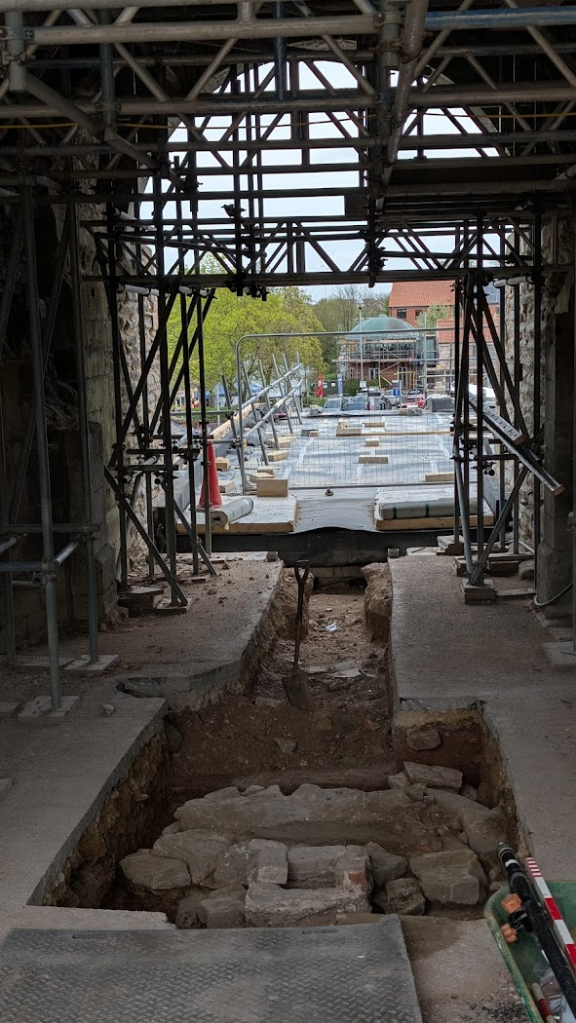
Looking out of the Gatehouse to the new stairs, showing the mortar cap over the well.
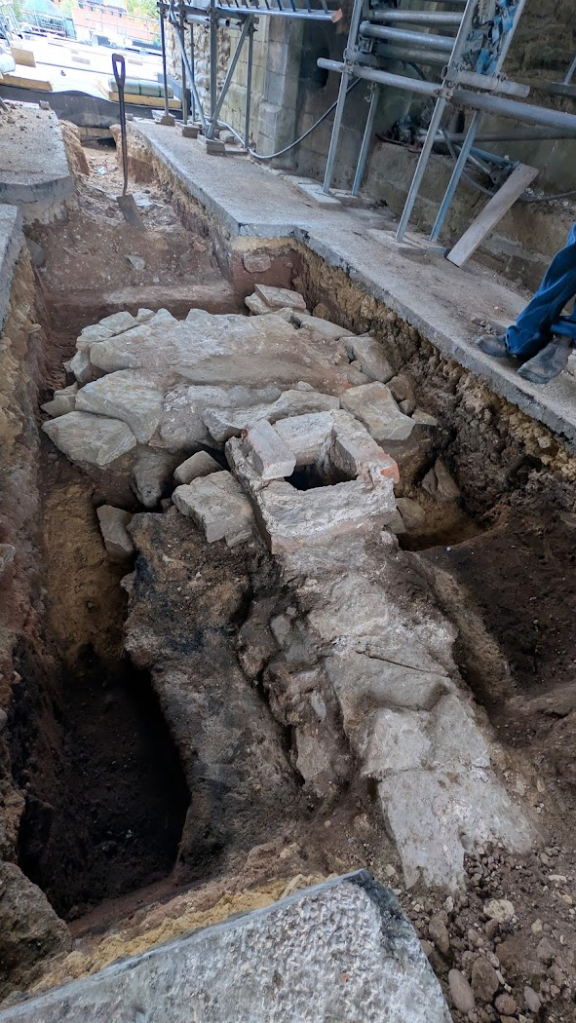
A closer look at the culvert which likely fed the well.
Contextualising the Gatehouse
Dr Marshall then helped frame the discussion around the well and its proximity to the porter’s office or lodge, with the aim of understanding whether the well’s location made functional sense — and, potentially, to aid in dating the feature.
Her deep familiarity with the building was invaluable, drawing attention to the scarring from the post‑Civil War slighting, where explosives had damaged the internal stonework. Being able to read the fabric in this way — to see past the centuries of change — added depth to the interpretation, even if it did not immediately explain the presence of the well.
A Wider Site Tour
We then climbed the scaffolding to examine the external elevations, guided by Dr Marshall’s acute observations, interpretative skills, and insights. This provided a clearer view of surviving window forms, the use of light and shadow in the original design, and the likely arrangement of earlier site structures now lost to later development. In a short time, the Gatehouse’s earlier phases became easier to visualise, even though much has changed around it. I will return to these observations in future blogs, such was the interest and site clarity offered in that short tour.
Why This Matters
Recent blogs have set out why Newark Castle is nationally significant: its rarity, its relative completeness, and its direct connections to major events in English history. This visit reinforced those points and added new layers of understanding — and new questions too.
The work underway is being carried out with great care, with the team preserving not only the visible fabric but also the integrity of the undocumented history still concealed beneath it. This is precisely why the site is scheduled — to protect what is known, and what is yet to be discovered. To think that you are inches away from pristine, undisturbed archaeology in such a place remains astonishing to me.
Looking Ahead
I left the site with much more to write about this visit. At home, my notes proved to span four additional blog posts. I have also visited Sleaford Castle (Newark Castle’s cousin) and have observations from that visit to share.
Next week I will turn to the creation of the viewing platform and the masons’ considerations in creating a stable, modern yet sympathetic footing on which to build it.
From the hoardings, you see none of this work. I hope these blogs help explain what is happening and bring this project to life.