Banbury: the last of the trio, Newark’s other lost cousin
1. A castle that slipped from the landscape
Banbury Castle is the most elusive of Bishop Alexander’s three episcopal castle sites. Sleaford still has its earthworks; Newark still presents its gatehouse (and later curtain wall to the river). Banbury, by contrast, has almost entirely disappeared. Its outline is known, its plan recorded, but its physical presence has gone.
What survives is the memory of its geometry, the results of archaeological excavation, and the way its footprint shaped the later town. Its absence is instructive. It shows how easily a castle can be lost, and how decisions made after the Civil War determined which sites endured and which were quietly absorbed back into the landscape.
2. Bishop Alexander’s third castle
Banbury was begun in the 1130s as part of Bishop Alexander’s architectural programme — the final piece of the trio that also included Newark and Sleaford. Like its siblings, it was an episcopal centre of authority, briefly confiscated by King Stephen in 1139 during The Anarchy, then restored to the bishop later that year. It remained in episcopal hands for four centuries, drawing castle‑guard obligations from the surrounding estates.
This long tenure places Banbury firmly alongside Newark. Both sat within the political currents of the 12th and 13th centuries, and both were intended as statements of episcopal presence. But Banbury’s role was different: it guarded the Oxford–London route, the bishop’s southern gateway to the royal court. That difference of purpose shaped everything that followed.
3. A remarkable design — known, but no longer visible
Archaeological work in the 1970s revealed that Banbury was completely rebuilt between 1225 and 1250, long after Alexander’s death. The new castle had a concentric pentagonal plan, with thick embanked walls more commonly associated with later castles such as Harlech or Beaumaris.

A much simplified plan showing how the concentric Castle design differs radically from an Episcopal Castle
Although nothing stands above ground today, the evidence gives a clear sense of its form: a pentagonal curtain wall, a central keep, a gatehouse (though its exact design is uncertain), and a full defensive circuit.
Alexander’s original castle was a rectangular stone enclosure with square towers, matching the architectural language of Newark and Sleaford. The pentagon belongs to the 13th‑century bishops, who rebuilt the site for a more militarised age. Banbury’s “difference” is therefore not a deviation by Alexander, but a radical reinterpretation by his successors.
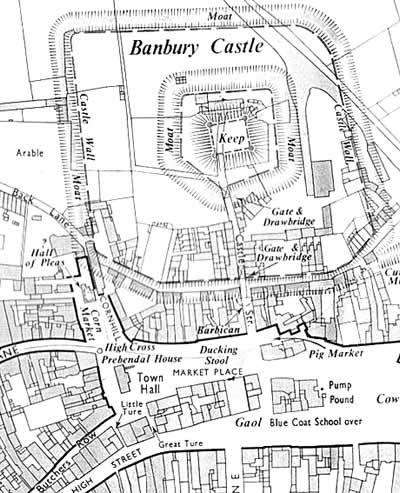
Extract of the post Bishop Alexander castle layout from ‘A History of Banbury’ by Alfred Beesley (1841)
4. A castle with many later lives
By the late 13th century, Banbury Castle had taken on a new role as a prison for the bishops of Lincoln. After passing into secular hands in 1547, the prison function faded, then reappeared in the 1580s as a place to hold recusants - Roman Catholics who refused to attend Church of England services. This layered history mirrors Newark’s own shifting identity: episcopal residence, royal stronghold, Civil War garrison, Victorian garden. Banbury’s story shows how these sites were repeatedly adapted to the needs of each generation, long after their original purpose had passed.
5. Civil War: the beginning of the end
Banbury played a significant role in the First English Civil War. Fortified by Parliament in 1642, it was captured by Royalists after Edgehill, strengthened, besieged in 1644, relieved, and besieged again in 1646. Charles I even dined there in November 1644.
The final siege in 1646 marked the turning point. With the Royalist cause collapsing, the garrison surrendered. Two years later, Parliament ordered the castle to be slighted - deliberately demolished to prevent further military use. Richard Fiennes, whose family had long associations with the site, received £2,000 in compensation.
From that moment, Banbury’s disappearance was swift. Its stone was quarried for houses; its earthworks were levelled; and within a generation the castle had been absorbed into the expanding town.
6. Reading what is no longer there
Visiting Banbury today requires a different kind of observation. There are no walls to examine, no gatehouse to interpret, no masonry to compare with Newark’s riverside façade. Instead, the story is read through: the curve of later streets, the recorded dimensions of the keep, the line of the ditch revealed in excavations. The knowledge that the castle once stood where modern buildings now sit is a reminder that absence can be as revealing as survival. What is missing tells its own story about the pressures on historic sites and the choices made long after their military relevance had faded.
7. Newark in context
Placing Banbury alongside Sleaford and Newark completes the picture of Bishop Alexander’s architectural legacy:
Sleaford — the quiet cousin: low‑survival, but legible
Banbury — the cousin that vanished almost entirely
Newark — the one that endured, its gatehouse and later curtain wall still giving the castle a presence the others have lost
Seen together, they show the full spectrum of outcomes for medieval castles - from survival to near‑erasure - and they highlight how fortunate Newark is to retain so much of its form and presence.
8. Why Banbury matters to Newark
Banbury’s story reinforces the importance of the work now underway at Newark. It shows how fragile these sites can be, how easily they can be lost, and how much depends on the decisions made in each generation. Newark has survived where others have not. The Gatehouse Project, with its careful, light‑touch approach, is part of that ongoing responsibility — ensuring that Newark does not join the list of castles known only through plans, excavations, and the shape of the streets that replaced them.