The Visitors’ Book That Never Existed: Footsteps Recorded, and Footsteps Lost
As I collated notes from this week’s site visit to the Gatehouse (more on that in my next blog), my mind drifted to the modern site visitor book — the A4 ledger of hard‑hat sign‑ins from masons, electricians, Historic England visitors, archaeologists, project workers, councillors, BBC reporters, and the occasional hard‑hat tour. It quietly records who stepped inside the works, who took responsibility, who was present on the day or in a moment.
It’s a tool for safety management, of course, but it is also a fascinating project artefact in its own right — a record of the people who shaped this new moment in the Castle’s long life.
And then the thought arrived:
What an artefact that would be. A ledger of power, crisis, ceremony, and quiet footsteps across nearly nine centuries — a human counterpoint to the stone.

Above - The imaginary ‘Visitors Book’
Missing Signatures — The Early Visitors
Medieval and early Tudor visitors would not have ‘signed’ a book in the modern sense. Their “signature” was a wax seal—careful, symbolic, and often more recognisable than handwriting, particularly in an age when few people could read or write. It was easier to recognise a distinct emblem than a written name. The seal validated the person; the description authenticated the act.
But imagine the entries, if they existed.
Bishop Alexander, the Castle’s magnificent commissioner, would appear often — inspecting works, approving masons, watching his Gatehouse rise stone by stone.
Then the royal pages would begin — a “Who’s Who” of English royalty.
Henry II, the great travelling king, passing through in 1180 during his royal circuits.
King John, arriving alive in 1216 and leaving very much dead.
Edwards I, II and III, moving along the Great North Road, their progresses marked by mounted retinues and the rhythm of medieval kingship.
Then the Tudors would arrive, and slowly pen and ink would take over from seal and wax.
Henry VII, almost certainly passing through on his progresses, consolidating his authority.
Henry VIII, whose vast circuits used the north–south artery repeatedly — his presence at Newark more than plausible.
Elizabeth I, whose progresses touched the Midlands, leaving elegant signatures and careful accounts.
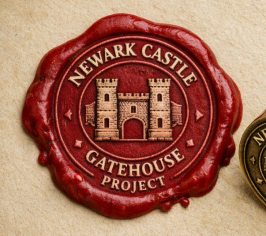
Above - A fictional wax seal from the Newark Castle Gatehouse Project
The Civil War Pages
Next would be the Civil War pages — dense, urgent, and unfortunately rather grim, and written rather than ‘sealed’.
Charles I, visiting repeatedly between 1642 and 1646.
Prince Rupert, commanding during the sieges.
Fairfax, tightening the noose.
And Cromwell, who probably never entered the Castle although the internet is convinced that he did.
Victorian and Edwardian Footsteps
Later entries would shift tone.
Anthony Salvin and Lewis Gilpin, sketching the ruins and shaping the riverside walk.
Turner, passing through Newark and sketching Trent-side.
And Edward VII, walking the riverside path with modern dignity.
Between those great names would be thousands of unrecorded footsteps: masons, clerks, guards, cooks, labourers, townspeople, and travellers. Newark Castle has always been a place of work, refuge, ceremony, and curiosity. Most visitors left no mark except the one they made on the day.

Above - Wikimedia Commons - JM Turner c 1796 Google Art Project
The Ledger That Never Existed
That Visitors’ Book of Newark Castle — if it had ever existed as a single artefact — would be priceless.
A ledger of authority, habit, and change, charting how materials, writing styles, and power shifted across the centuries. It would show how the Castle was not just a backdrop to history, but a participant in it — a place where decisions were made, alliances forged, crises endured, and ordinary life carried on in the shadow of extraordinary events.
Maybe in a millennium or two, someone might study the site sign‑in sheets from this Project and wonder who on earth 'Barry the Blogger' was… or perhaps not.
But the Castle will endure. And the footsteps — ancient, modern, and somewhere in between — will remain part of its story, as moments in the unbroken length of England’s rich history.
The Gatehouse Project preserves those footsteps and seeks to add more when it re‑opens — welcoming guests, guiding them through restored spaces, and letting them marvel at the footsteps that went before their own.