Why Bishop Alexander Built in Stone - A Baron Bishop, a French Education, and the Logic of Power
This week I turn to the scarcity of surviving Norman Gatehouses in England, explaining a little further why the Gatehouse Project is so important.
From Timber to Stone
When Alexander became Bishop of Lincoln in 1123, Newark was already an episcopal centre: a timber fortification on a rise above the Trent, regulating movement, collecting revenue, and projecting authority. Rebuilding in stone was not innovation but consolidation — a way to anchor episcopal power in the landscape with permanence timber could never provide.
A Baron‑Bishop, Not a Quiet Administrator
Alexander was a baron‑bishop, operating at the level of major secular lords. Newark and Sleaford were not retreats but administrative hubs. For a figure of his rank, stone was practical governance: it signalled status, secured assets, and made jurisdiction unmistakable.
A French Birth and Education
Educated in the intellectual world of Laon, Alexander came from a culture where bishops routinely expressed authority through stone residences and fortified precincts. He brought that expectation with him. Newark’s stone phase reflects this continental understanding of how a bishop should appear — permanent, legible, unavoidable. The pale stone familiar from Laon’s architecture, echoed in Newark’s medieval fabric, may even have offered continuity for a man working in a recently conquered realm.

© By Pline - Own work, CC BY-SA 3.0, https://commons.wikimedia.org/w/index.php?curid=16457282 - from Laon France, showing the similarity of the warm colour of stone.
This background explains the confidence of his building programme. Newark and Sleaford show Alexander asserting permanence across a wide territorial network. The Nottinghamshire Heritage Gateway depicts a region dotted with fortifications, but few were episcopal stone castles.
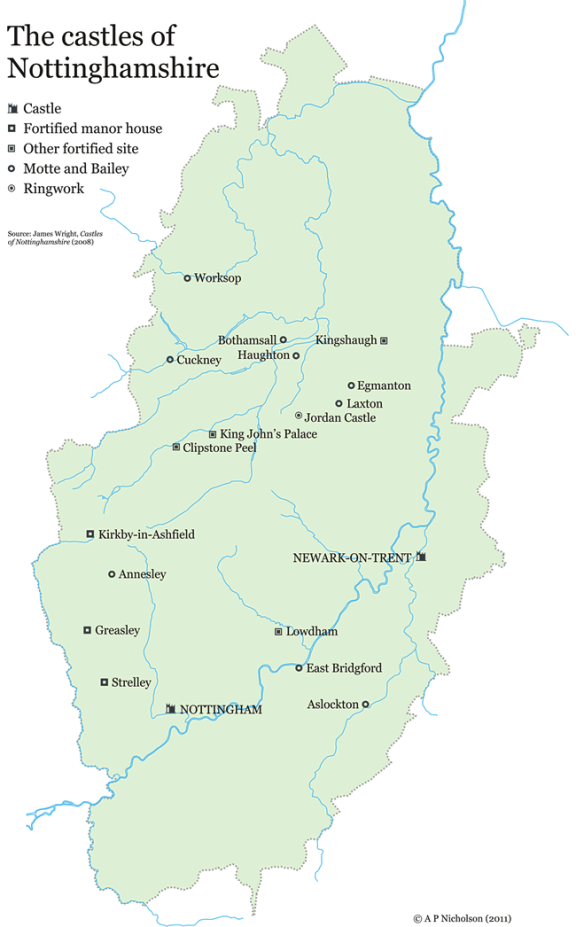
Extract from the online Nottinghamshire Heritage Gateway Resource
The Salisbury Connection: A Family Tradition of Power‑Building
Alexander’s uncle, Roger of Salisbury — Henry I’s chief minister — shaped a political culture where architecture and administration were inseparable. His works at Sherborne, Devizes, and Salisbury created fortified centres of governance rather than simple defensive sites. Alexander’s programme belongs to this same tradition. His later epithet “the Magnificent” reflects not personality but the scale and coherence of this architectural strategy.
Lincoln: The Centre of a Vast Episcopal System
Alexander’s authority radiated from Lincoln, the largest diocese in England, anchored in a major city with a mint, markets, and established administrative machinery. Newark was one of the points where that authority met the landscape. It was never a local vanity project but a strategic node in a wider system.
A Bishop with a Building Programme
Alexander’s works formed a deliberate network:
- Lincoln as spiritual and administrative centre
- Newark securing the Trent crossing
- Sleaford controlling movement along the fen edge
- Banbury marking the southern boundary
Together they created a coherent framework of episcopal control. Newark’s stone rebuilding must be read within this system — a bishop asserting durable authority in a kingdom where land, wealth, and jurisdiction were tightly interwoven.
The Economic Logic Behind Stone
Norman England was compact, centralised, and highly taxable. The bishops of Lincoln were among the wealthiest magnates in the realm. Newark’s position on the Trent made it a key point for tolls, trade, and movement. A stone castle strengthened that role by providing:
- secure control of river traffic
- a stable administrative base
- a visible assertion of jurisdiction
- long‑term protection of assets
Stone was therefore an economic instrument as much as an architectural one.
Architecture as Governance
Alexander’s stone works at Newark were not primarily military. They were tools of governance: a gatehouse controlling access, a wall defining the precinct, a riverside frontage signalling authority to anyone travelling the Trent. The design expresses a simple logic: control the crossing, and you control the movement — and the authority that flows with it.
Conclusion — Why the Gatehouse Project Matters
Newark Castle’s gatehouse is not a picturesque fragment but a surviving component of the Norman engine of state. Built by a baron‑bishop at the centre of one of Europe’s most centralised kingdoms, it fixed authority into the landscape with deliberate intent. What remains is exceptionally scarce — one of the few Norman episcopal gatehouses still standing — yet it cannot currently be entered or understood as it was designed to function. Its architectural logic survives, but remains inaccessible.
This is why the Gatehouse Project exists: to restore access, reinstate legibility, and allow people to understand the building as Alexander intended — as a controlled threshold, a statement of jurisdiction, and a rare surviving expression of episcopal power in stone. Making that experience possible is not embellishment but historical necessity.
Blog 6 will examine the architectural character of Alexander’s stone castle: what survives, what is lost, what the material evidence reveals — and finally reveal Newark’s “other castle”.
